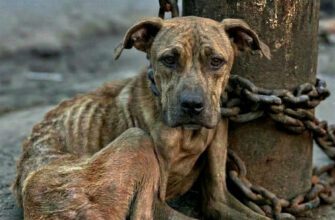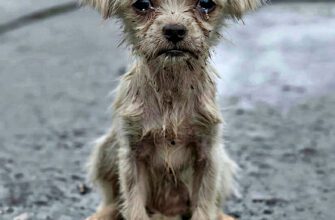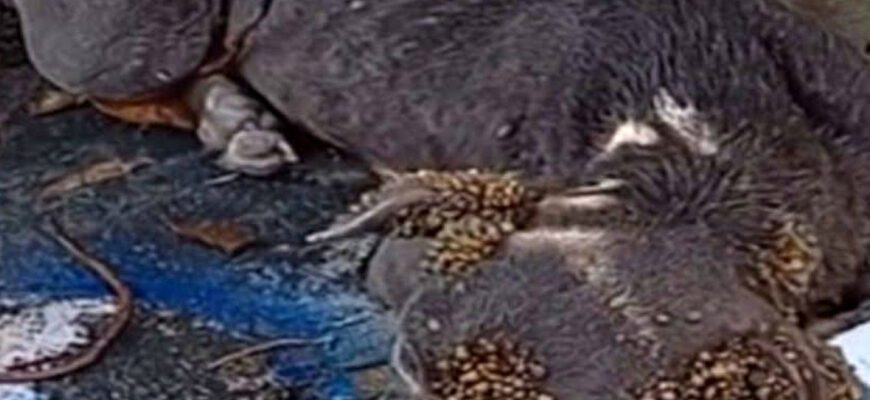
The morning was as if the city were exhaling moisture and fatigue at the same time: cold steam rose from the slabs on the ground. A dog lay against the concrete wall of the warehouse, curled up in an awkward position, reminiscent of a built-in survival device; its fur was dotted with gray grains of alien life, and a narrow, deep furrow of thin wire was visible on its neck. Beside it was a spot of blue paint, as if someone had sealed its fate and left. I placed the broom against the wall, squatted down, placed a cotton sheet from the laundry under its head, and felt its breathing—small and orderly—respond to my silence. I covered it with my hand, and the tremor in it died away.
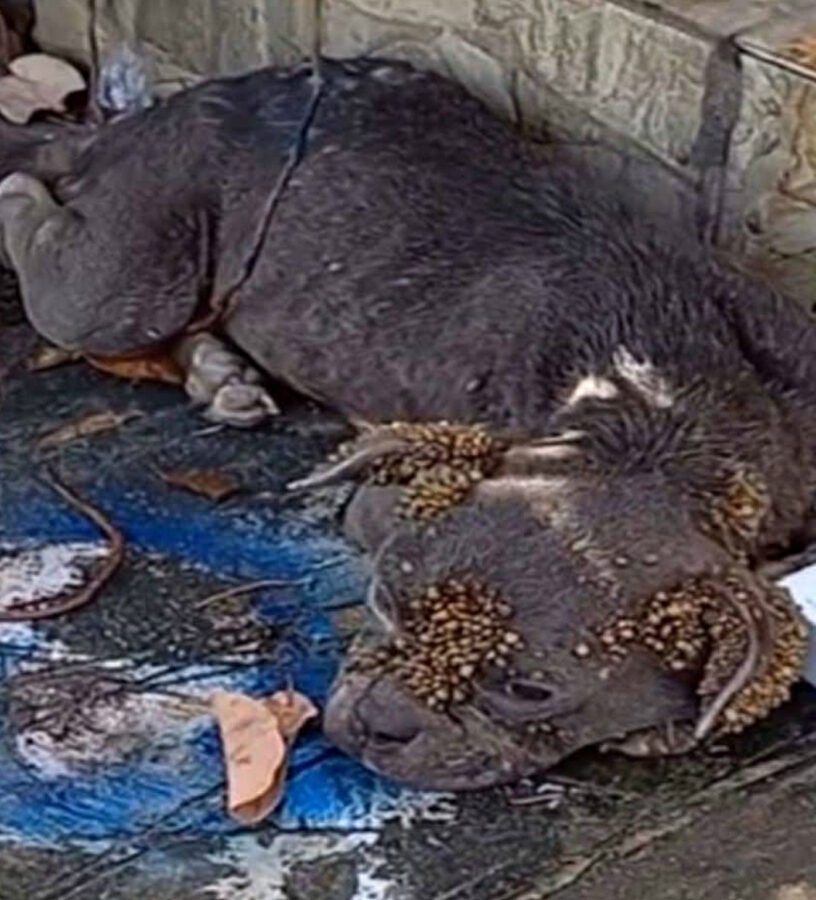
A security guard approached us with the smudged face of a man accustomed to calling for order. He briefly suggested that we call for a catch—to do everything “according to the rules” and without emotion. I replied that I would call later: it was important to carefully carry her to the tram now, because any sharp sound would h.u ŕt her. The man looked at us for a long time, then gave up and brought an old sheet, which I carefully wrapped around the dog’s body. She offered no resistance—not out of trust, but out of lack of strength.
“Regulations are a tool, but sometimes people can contain more humanity than paper,” I thought as we walked to the tram stop.
The conductor quietly told me to sit by the door and hold the cover tightly; her gentle tone stopped the small panic shudders in me. In the hospital, the smell of bleach evened out the atmosphere, and at the reception a young woman politely but clearly said that the treatment would be long and expensive. I asked to have all diagnoses and actions recorded in my name—I needed clarity, not promises. We were led to the box office, where incredibly calm lighting and professional silence allowed the dog to rest.
The doctor, collected and focused, quickly examined the ears, eyes, skin, and lungs. Her fingers were confident and without fuss; she immediately said that the condition was serious, but the eyes were alive—that gave him a chance. They cleaned him, removed the wire, started IVs and skin treatments. The plan was simple: remove the source of p.a ìn, replenish the body’s strength with food and warmth, and find a safe space for gradual recovery.
- Sanitation and pain relief;
- long-term infusions and w.o ∪nd care;
- nutrition and quiet as part of recovery. When the metal clicked and stopped squeezing my neck, the sound was more devastating than any previous quarrel I had ever heard. I sat down next to her, tried to tell her about myself in simple words—my name was Polina, my job as a cleaner in a warehouse yard, my room in a dormitory, a blanket that smelled of washed longing. I talked about how I didn’t have much money, but I had enough soul to stay by her side; that I had once been silent when I needed to speak—and that silence would ring out later. My words were sloppy, but sincere; and somewhere in the middle of this simplicity, the dog’s small breathing took a deeper breath—as if my story had put a piece of p.a ìn on the shelf.
“Sometimes staying close is more important than looking like a hero,” I said to myself and continued to monitor the drops.
On the third day, another employee of the service came into the reception area with a form — his language was carefully regulated: a sick animal was found at the address, it needs to be registered and picked up. I explained that the dog was being treated and was under my care; the doctor confirmed this with documents. The man looked at the papers for a long time, then at me, and it seemed that an internal shift had occurred in him: he was silent until the doctor spoke the algorithm for further actions.
Gradually, the dog began to react to the sound of my step — she raised her head and looked without fear. I gave her the name Luna: a weak night ray flickered in her eyes, which did not illuminate the room, but relieved her heart. When we took her out into the quiet courtyard of the clinic, she walked cautiously, as if every touch of the ground was a new deal.
- The name was chosen because of the soft light in the eyes;
- slow socialization with the person;
- rebuilding trust in small steps.
Later, an elderly neighbor from the laundry came and said that she had seen Luna near the garages — she was being held on a chain by some guy; then he disappeared, and the dog was abandoned. She agreed to show the place and said that she was afraid of a.n ĝer, but hoped that we could manage without him. This began a slow quest: to find traces of the past, to dot the “i”s and give the animal a chance to develop a new story.
In the garages, where the smell of motor oil mixed with promises of “I’ll fix it” and “tomorrow”, the owner of the box met me with an insistence supported by his voice. He said that the dog seemed to “pull up everything around” and that there were traces of metal on its neck — he explained this as a necessary measure. I silently looked at the tracks and felt how he was becoming uncomfortable: somewhere under the external rigidity he felt that someone had come and was not afraid of his voice.
“Who is not afraid changes the rules of the game,” I told myself as I returned with the address written down.
When Luna was discharged into my care, she sniffed every corner of my room: the bowl, the blanket, my shoes, the battery—as if she were setting up a heat map. I touched her neck and felt the fabric become softer under my fingers. The next day, the employee who had once offered to catch her came with a receipt from the pharmacy and a bag of medicine: he asked to pay for it himself, because he realized that instructions without a heart were useless. We accepted his help—sometimes it is a timely hand that creates respect between people.
Soon a girl in a threadbare jacket and a boy of about eight with a toy car knocked on my door—they brought an old collar with a tag “Luna” and on the back in childish handwriting the word “Home.” The girl was afraid to speak, but she spoke the truth directly: she and the boy lived next to the garages and had watched the dog for a long time. The boy quietly raised his hand — and his request to come sometimes was so sincere that Luna carefully touched his palm. She felt that the word «home» could mean something different when spoken not with a word, but with acceptance.
- the old collar returned the name;
- the children’s inscription «Home» came to life in action;
- adults and children together create the safety of the animal.
We returned to the concrete corner where the paint had once drawn a sentence; the man from the service came with a solvent and a rag to wipe away the stain. I took a piece of chalk and wrote, unevenly but confidently, “To live.” This involuntary act—cleaning off the paint and the word on the concrete—felt more important than a thousand loud statements on social media. That night, Luna slept next to my hand, her face resting on my palm; her breathing became even, and I allowed myself to c.r ɣ quietly—not from p.a ìn, but from relief.
Later, the security guard from the warehouse called and said that he had also contacted the volunteers and offered to help with the premises. One of the unexpected gifts was the decision of the dormitory administration to allow a pet—a piece of paper appeared on the door of my room with the order: “Permit to live with a pet.” It is guided by memory: the owner of the hostel showed me a yellowed photo of a dog on the wall and confessed that his name was Luna too. He asked me to keep it, and I felt how simple things — a bowl, a blanket, a warm place — took on great weight.
“Hope does not always come with light — sometimes with the weight of care,” was how I explained to myself each small step of recovery.
Conclusion: This story is about how a sequence of good deeds changes a life: one person who decided to stay; a veterinarian who gave her a chance; neighbors and the service that finally stopped acting only on papers; a child’s faith written in crooked handwriting. The clay on Luna’s paws is the s.c αrs of the past, but despite them she found warmth, a roof, and a quiet, attentive voice next to her. Small actions—a careful twilight conversation, a clean sheet, a smoothed coat, a rubbed-down paint, the German word for “to live” on concrete—add up to make a home. Take care of the animals and people who risk staying: that’s what makes our world a little more humane.
➕