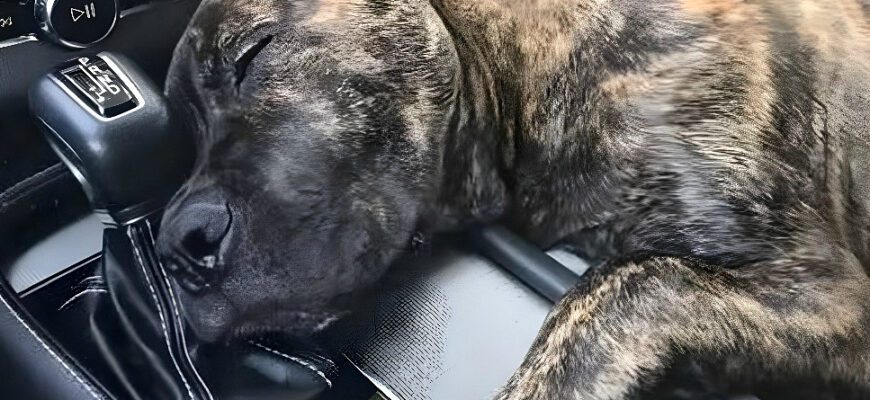
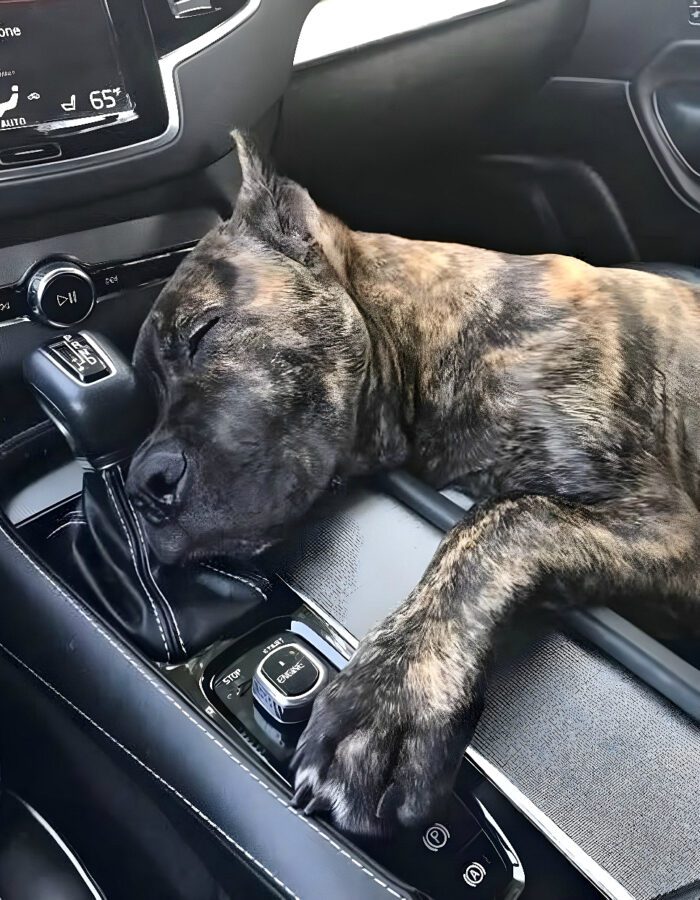
They found him on a warm afternoon, lying motionless across the center console of an abandoned car — a place that should have been uncomfortable, yet it was the only spot where he finally felt safe enough to sleep.
His breathing was shallow, his body trembling from exhaustion. The rescuers immediately noticed what the passersby had failed to see: the swelling on the top of his head, an inflamed, p.a ìnful mass hidden beneath his fur. It pulsed with heat, and every tiny movement made the dog flinch.
But he didn’t run. He didn’t protest.
He simply opened his tired eyes, looked at the humans kneeling beside him, and made a decision that changed his life:
he trusted them.
When they lifted him into the transport van, his head rested weakly against the rescuer’s arm. They could feel the warmth radiating from the swollen area — a clear sign of infection. Hours later, at the clinic, the truth came out: the dog had suffered a severe w.o ∪nd to the skull long ago. It hadn’t healed properly. Instead, it had turned into an abscess, spreading deeper, pushing against nerves, causing constant throbbing p. αin that he had silently carried for weeks.
The veterinarians worked fast.
They shaved the fur around the wound, drained the infection, and cleaned the tissue layer by layer. The dog didn’t fight back. He didn’t c.r ɣ. His eyes simply followed the hands trying to help him, as if he couldn’t quite believe someone was finally doing it.
When the procedure was over, the doctors wrapped his head in a soft protective bandage. He looked almost comical — a tired warrior with a white “helmet” — but the team couldn’t laugh. They knew how close he had been to losing this b.a ŧtle. Another few days without treatment, and the infection would have reached his brain.
That night, he stayed at the clinic under observation.
For the first time in a very long time, he slept deeply — no trembling, no gasping for air, no frantic searching for a safe place. Just peace.
The next morning brought a moment the rescuers would never forget.
When one of the volunteers entered the room, the dog stood up, weak but determined, walked to her slowly… and gently pressed his bandaged head against her c.h ℮st. It wasn’t a request for food.
It was gratitude.
Day by day, the swelling went down.
His appetite returned.
His tail began to move — just a little at first, then wider, freer, like a small flag announcing his comeback to life.
The rescue center made a promise: he would never return to the streets. They contacted a foster family experienced in caring for animals recovering from head injuries. When they arrived to pick him up, he greeted them with that same shy tail wag — the signal that he was ready to start a new chapter.
In his foster home, he learned what comfort truly meant.
Soft blankets.
Regular meals.
Gentle hands cleaning his bandage.
Warm voices calling him “good boy.”
He followed his foster dad everywhere, resting his head on his knee whenever he sat down, as if making sure love wouldn’t disappear again.
Weeks later, when the day came to remove the last bandage, everyone in the clinic gathered to watch. The w.o ∪nd had healed perfectly. The fur would take time to grow back, but the doctors smiled — not because the in.j ∪ry was gone, but because the dog standing before them was no longer the frightened, exhausted creature found collapsed in a car.
He was bright.
Playful.
Hopeful.
Alive.
And then something beautiful happened.
The foster family, who had promised only temporary care, looked at him — at the dog who had learned to trust them completely — and realized they couldn’t let him go.
They signed the adoption papers that same afternoon.
The dog who once lay trembling on a cold car console now sleeps in a warm bed every night, safe beneath the gentle hands that healed both his body and his heart.
➕