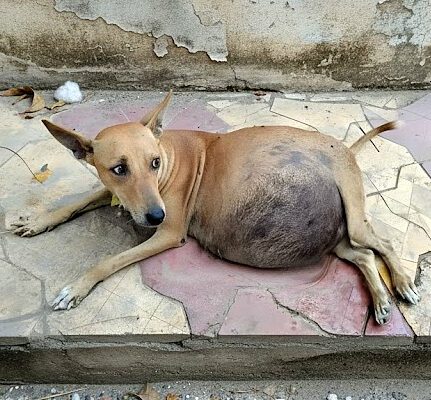
Kunti’s story is a vivid reflection of human indifference. In a forgotten corner of the world, her body became the site of a t.r αgedy that had no words. Each new day only deepened her s.u ƒfering, like a poison that poisoned her veins, gradually dest.r σying her. Defeat and powerlessness became her constant companions. There was no relief — only the heavy burden of disease and alienation.
The toxic discharges that came from her body were not only physical symptoms, but also evidence of the c.r ∪elty she had endured. Every drop spoke of the be.a ŧings, the endless hours of loneliness and the lack of compassion. Her skin, covered in w.o ∪nds and s.c αrs, told a story of v.i σlence that no one wanted to hear.
Inside Kunti, an even more b.r ∪tal t.r αgedy was taking place. Her puppies, the very little creatures that were supposed to be her hope, d.i ℮d before they were born. Her belly, once a haven of life, had become a silent g.r αve. Decay was taking hold of her body, turning it into a prison of hopelessness. No joyful sounds, no warmth of a new beginning – only silence, d.e αth, and de.c αy.

Kunti lived on, but her existence had become a shadow. Every breath reminded her of what she had lost. Her eyes, dull and hazy, reflected a p.a ìn that went beyond the physical. It was the p.a ìn of a mother who could never hold her children, of a v.i ćtim who never received justice, of a being reduced to nothing by indifference.
The cage where she was found was dark and cold, a space that swallowed up all hope. There she dozed, motionless, as if the whole world had collapsed on her. No barking, no complaining—only silence. And that silence screamed louder than any sound; it spoke of leave and defeat.
The veterinarians who treated her confirmed what her body had already hinted at: the puppies were d.e αd, her body was infected, and her life hung in the balance. Only emergency surgery could save her from the clutches of d.e αth. But even as her body slowly began to heal, the emotional s.c αrs remained indelible.
Kunti is a reflection of thousands of animals who s.u ƒfer silently. Her story is not unique, but it is a stark reminder of what abandonment is. Every blow, every day without food, every night without shelter, leaves s.c αrs that do not heal. When motherhood becomes a g.r αve, the p.a ìn reaches unfathomable dimensions.
Physical recovery may be slow, but the memory of the su.f ƒering remains. Kunti needs care, she still depends on the compassion of those who have chosen not to turn their back on her. Her spirit is already showing some signs of improvement, but the shadows of the past are still there. They are invisible w.o ∪nds, deep ones that will never fully heal.
Her story forces us to look into the face of c.r ∪elty that we often ignore. It reminds us that behind every abandoned animal is a universe of p.a ìn, l.o śs, and injustice. It poses an uncomfortable question: how is it possible that creatures capable of feeling, loving, and s.u ƒfering are subjected to such indifference?
Kunti, the unfortunate mother dog, survived. But her survival is not a triumph, but a warning. It is proof that life can endure even in the harshest of conditions, but it is also an indicator that the system is failing, humanity is forgetting, and society is allowing su.f ƒering to become the norm.
In her weary eyes, on her da.m αged body, in her heartb.r ℮aking silence, lies a truth we cannot ignore: abandonment is a form of v.i σlence, and every vi.c ŧim carries a t.r αuma that will never heal.
➕