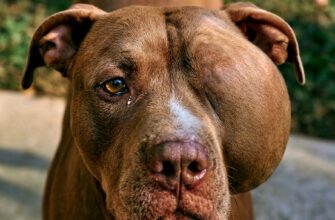
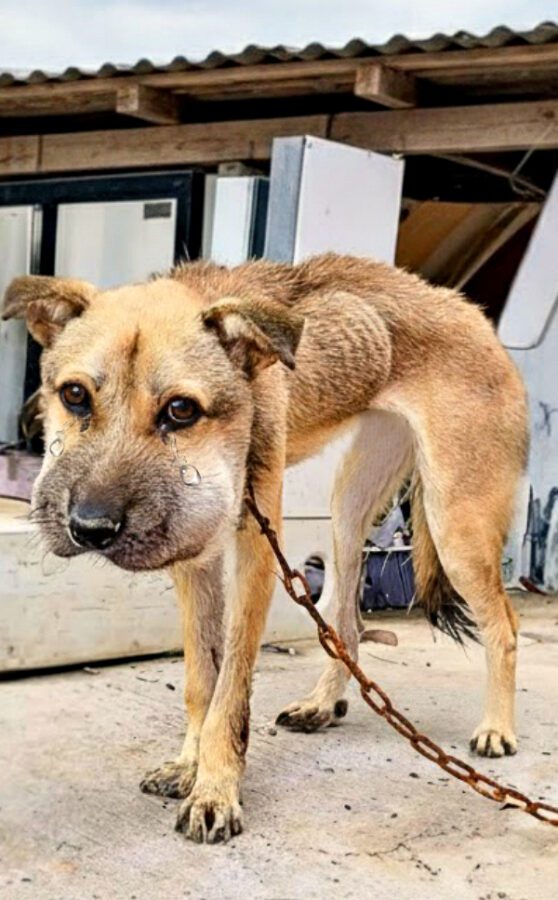
He stood at the concrete threshold like a shadow, tied to a strange house. A rusty chain la.c ℮rated his neck, an iron ring str.i ρped his skin to b.l σody scabs. His face was swollen, alien—as if someone had jammed a fist under his skin and refused to let go. His lips trembled with every breath, and a string of fly-caked saliva hung from the corner of his mouth. There was dirty water in the bowl, and a piece of stale bread beside it. But he couldn’t bite—the p․a ìn in his jaw was stronger than hunger.
The yard was cramped, fenced in with chain-link fencing. Used tires, plastic bottles, boards with nails. Everything h․u ŕt. The neighbors had grown accustomed: «redhead on a chain,» «bad,» «let him watch.» They watched the swelling grow, but passed him by indifferently. A person can become accustomed even to su․f ƒering, even if it wasn’t their own.
The swelling grew. First a small pimple, then half of his muzzle. The dog stopped barking because every sound reverberated with p․a ìn in his bones. He slept standing up, because lying down was even worse.
The owner rarely went out. Flip-flops, a quick throw of something into the bowl, sometimes a k․i ċk when the chain got tangled underfoot. His words were hard and indifferent: «go away,» «quiet,» «doggie.» They looked at him like a tool, not a living creature.
Then one evening, a woman peeked in. She opened the gate and saw eyes that had long since stopped pleading, but still remembered the meaning of hope.
She crouched down, took out a collapsible bowl and a bottle of water. She poured it. The dog took a step, then another. The chain clinked. He touched the water with his tongue—p․a ìn shot through his skull, and he recoiled. He tried again. On the third sip, the water became medicine.
With trembling hands, the woman wrote to the volunteers: address, photo, «swollen muzzle,» «chain,» «urgent.» The reply was quick: «We’re going.» She stayed with him until dusk fell. She kept repeating in her mind: «Just make it in time.»
The owner finally emerged. He yawned and looked at her:
«What about you? It’s not your dog.»
«He’s s․u ƒfering. He needs treatment.»
«Then treat him. I don’t need a s․i ćk caretaker.»
He said it as if he were talking about a broken shovel. Then the dog realized there was no home for him. But someone else had already made up their mind.
A moment later, volunteers entered the yard. Metal scissors squeaked as they cut through the rusty chain. When the tension broke, the dog staggered. He only held on because the woman held him. For the first time, his neck was free.
The clinic smelled of medicine and clean towels. The doctor looked into the dog’s eyes and said,
«It’s tough. But not too late. We’ll make it.»
The dog didn’t understand the words, but he understood the tone of voice. For the first time in months, someone wasn’t pushing him away, they were saving him.
The night at the clinic had its own rhythm: the soft hum of oxygen, footsteps, the clang of metal. The woman sat at the table, holding his head. In the morning, the swelling was less. The doctor smiled with his eyes:
«He’ll live.»
They named him Rudy. The name stuck to him like a bandage on a w․o ∪nd.
A few days later, he was lying at home on a soft blanket. He drank cold water from a clean bowl and ate wet food. For the first time in a long time, he ate calmly, without fear of being taken away. At night, he checked: was the chain back? No. Just a soft harness and a warm hand on his forehead.
Week by week, the p․a ìn subsided. A small metal shard in his tooth was removed, and the s․c αr remained—but it didn’t h․u ŕt. It became his story. He learned to trust: first a bowl, then an open hand, and finally his own reflection in the mirror.
On walks, he inhaled the scents of the world: wet bark, fresh bread, children’s hands with an apple. And when a bus passed, he would stop and look at the woman. And she would repeat calmly:
Neighbors whispered: «Pitbull?», «that dan․g ℮rous redhead?» But his gaze wasn’t menacing. It was attentive. The children learned to pet him slowly, starting from his c․h ℮st, just as the volunteers had taught. Redhead accepted their serious affection with patience.
At the checkup, the doctor nodded:
«He’s recovering. There will be a slight asymmetry in his face. But let it be. It’s his story.»
And history was being written every day: a bowl of water, a walk, a nap under the radiator, sun on the floor.
The woman sometimes returned to old photos: the crippled water, the swollen face, the empty eyes. These images gave her chills. But she didn’t delete them. They were proof.
Now Rudy slept beside her. When he was happy, he smiled crookedly—where it had once h․u ŕt. And in that smile lay the answer to all questions: «It was worth saving. Always.»
➕