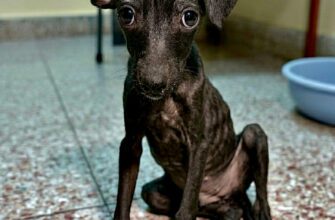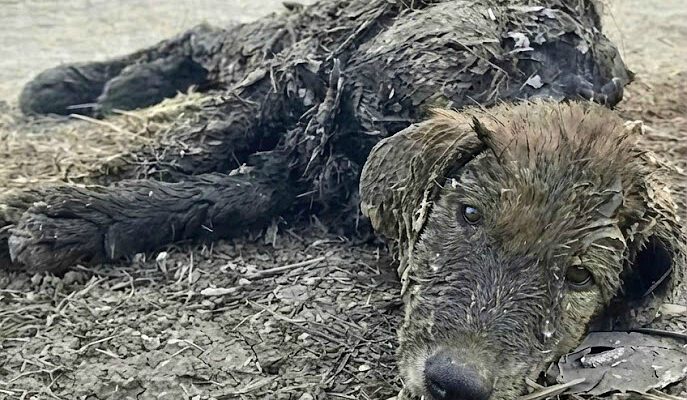
He was carried out in an old feed sack. The sack smelled of dust and mice—and that smell would forever be intertwined in his memory with a sharp fear. The car stopped in the middle of nowhere, where the road split into two ruts and disappeared into the undergrowth. The man whose steps he knew by heart opened the door, yanked the sack to the ground, and, without looking, pulled the rope. The dog tumbled into the gray dust, st.r ∪ck his shoulder, and his vision darkened. He raised his head—only enough to see a heel, the slammed door, and the red flash of brake lights.
The car sped away a few meters, then accelerated and disappeared, leaving a trail of exhaust behind it. At first, he didn’t believe it. «He’ll be back soon. He’ll say, ‘What, you f.o σl, scared?'» He sat down, tucking his paws under—a habitual waiting. But time passed, and no one returned. The wind whipped through the weeds, pale clouds drifted across the sky, and a garbage can lid rattled nearby—someone was rummaging inside. Dust stuck to his damp nose, and his mouth tasted bitter.
He tried to stand—his hind legs were tangled, his strength almost gone. A few days earlier, he had eaten only leftovers and drank thin water from a rusty bucket: «There wasn’t enough for food, you’ll have to wait.» He waited. And he got it—just not what he wanted.
He lay there until his skin was warm from the earth. The smells of the wasteland—stones, iron, rotting grass—were all the same, and among them the most important one was lost: the smell of his old home. He listened and found nothing. And then, for the first time, he understood: there was nowhere to return.
People appeared in the evening. Two teenagers on bicycles, cackling, rode closer to see «what kind of animal is lurking there.» One p.r σdded him with a stick—the dog flinched but didn’t growl. Growling was pointless: it doesn’t work on those who leave. A woman with a heavy bag walked around, muttering, «Where are these shelters looking?» The man in camouflage stopped, pursed his lips, but continued on: «I have my own affairs.» It’s always like this in the wilderness: this is where the roads end and no one’s responsibility begins.
The night grew cold. He tucked his paws in, tucked his nose under his tail—to avoid hearing his own ragged breathing. He felt the dampness—it was coming from the city through the canal. He fell asleep and woke to a rustling sound: a fox was pulling chicken bones from a shopping bag. The dog raised its head, the fox crouched, looked with amber eyes, and disappeared silently. «She’s free. And I—not,» he thought wordlessly. His invisible chain was inside: the fear of taking a step and having nowhere to go.
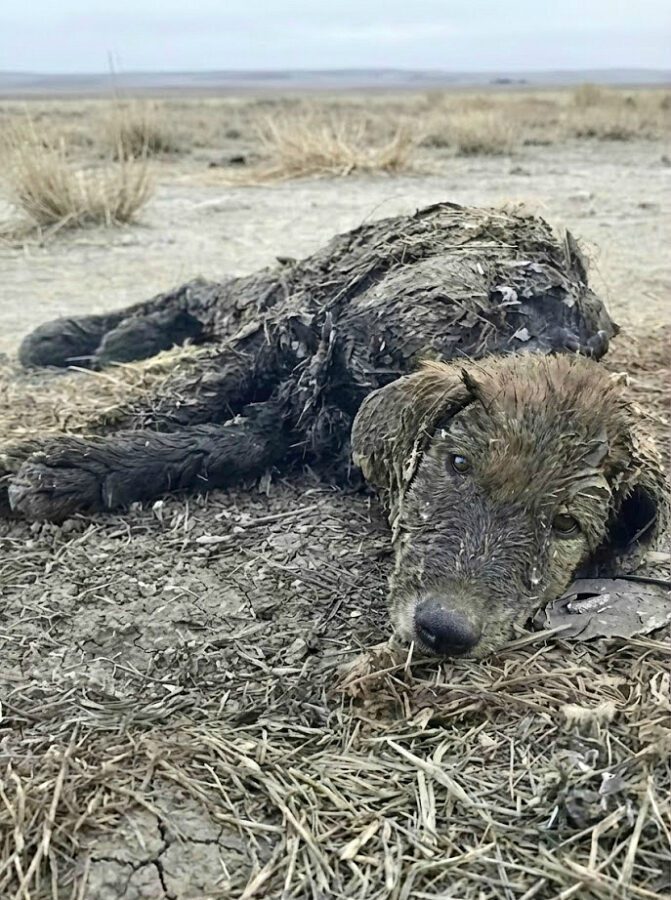
Early in the morning, a yellow truck with the municipal services logo pulled into the wasteland. A boy in an orange vest got out, stretched, and took out the bags. He only noticed the dog up close—the same dust, the same gray hues. But when he approached, the dog opened its eyes, and the boy froze.
«Hey, friend…» he said quietly, as if to someone sleeping. «What are you doing here?»
The dog didn’t move. Hesitation flickered in the boy’s eyes: work, deadlines, a boss. Yet he crouched down, poured water from a canister into the cap, and offered it to him. The dog craned its neck and drank—carefully, as if every drop might disappear.
«You’re alive,» the boy sighed. «And you’re very light.»
He dialed a number, quickly explained something, nodded, «I’m waiting.» Then he sat down next to him and simply was. He knew exactly what it was like to be «thrown out»: he himself had returned from a construction site in the summer with nothing. Unnecessary—a word that sticks to the skin.
Twenty minutes later, the volunteers arrived. A girl with short hair, a boy with a carrier, bandages, and a loud phone. The girl ran her hand along his spine—there was more air than muscle under his fur.
«Absolute devastation,» she said. «An IV is necessary immediately. Can we lift him?»
The dog wanted to say, «No need to lift him, I’ll just lie there,» but they were already carefully taking him under his c.h ℮st and hind legs. They placed him in the carrier, covered him with a blanket—and for the first time in twenty-four hours, he stopped shivering.
The clinic welcomed him with light and the smell of cleanliness. The doctor—a short man with attentive hands—spoke without unnecessary words:
«Cachexia, dehydration, skin sores, matted fur, temperature below normal. We’re starting an infusion: glucose, antibiotics, painkillers. X-ray after stabilization.»
They laid him on a heated mat. A warm needle entered his vein, and the world, compressed into a tiny dot, began to expand. He heard the drips in his IV, the siren in the street; he heard the girl whispering:
«You’re not a bag. Do you hear me? Not a bag.»
He didn’t know the word «bag,» but he understood the meaning. It grew quieter inside.
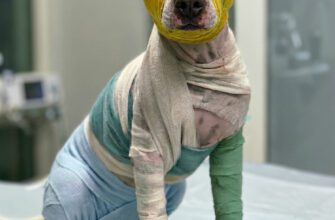
For the first few days, he didn’t try to get up. They washed him with warm water, cut out the knots, and applied cream to the w.o ∪nds. He reacted especially well to this cream: the faint, homely scent opened forgotten doors in his memory. Sometimes he jumped in his sleep—he was running away. Then they placed a hand on his c.h ℮st: to let him know he didn’t have to.
He was given a name—Grey. Like the color of dust and like a new page in his life. The name stuck quickly; he reacted first with his ear, then with his whole body: he turned his face away when he heard a soft «Grey.»
On the third day, he took his first independent sip of food, softened in broth. Then a second. He ate slowly, pausing, as if making sure no one would take it away. With each bite, his pupils became rounder, his gaze more alert. Like a thin thread of green growing out of the desert.
The doctors wrote down in the chart: «appetite +,» «calm reaction,» «weight +300 g.» Little things, but they’re the stuff of a comeback.
When they first led him out into the clinic’s small courtyard, he stopped, tilted his head, and inhaled—so deeply that his c.h ℮st ached. It smelled of wet earth, pine trees, and coffee from someone’s mug on the windowsill. He froze and listened: the world was different again.
«Yes, Grey. Come back,» the girl smiled.
At the same time, volunteers were looking for a foster home for him. «Big, quiet, non-confrontational, very tired, needs warmth and regularity,» they wrote in their posts. Comments reported that someone had seen a similar car in the middle of nowhere, but nothing could be proven. There would be no punishment. But the posts were important: they turned an «unnecessary thing» into history. And history is harder to get rid of.
A home was found for Grey at the end of the second week—a small ground-floor apartment with a high window. The owner, a librarian, hesitated for a long time: «Will I be able to handle it?» But when she arrived at the clinic and Grey placed his muzzle on her hand, the answer came naturally.
They drove home in silence. Grey, in the backseat, opened his teeth for the first time in a long time—he simply yawned, as if he were alive.
He slept the first night by the window—where it smelled of the street. The second—closer to the couch, on the carpet. The third—he moved his bed to where his owner read in the evenings: a simple task: «to be there.»
He woke her in the morning with a quiet touch to his nose, as if checking: «Will you disappear?» She didn’t.
He was given rituals: meals at set times, walks—short at first, then longer ones, grooming—a brush, which he was initially afraid of, and then he’d cradle his neck. He quickly learned the words «can» and «after.» «After eating—water,» «after the walk—paws,» «after the fear—I’m here.» These «afters» came together like a puzzle.
Sometimes the past returned. Once, a flash of red flashed in the window and the sound of brakes—Gray froze, then lay down and pretended he didn’t exist. His owner turned off the light, sat down beside him, and whispered, «That’s the wrong car. We’re home.» He shivered for another minute, then rested his head in her lap. The fear receded like nighttime water from the yard.
He slept a lot—his body was catching up with life. In his sleep, he moved his paws as if he were running: not from, but to.
After a month, he had a favorite path—along the school fence, then to a square with a huge poplar tree. A man in gray shoes was jogging there in the morning; one day, Grey walked alongside. They walked the entire circle, and the man said, «Bravo, comrade.» Grey jumped with joy and sneezed happily.
At his checkup, the vet wrote: «Weight +3.4 kg, skin clear, tests normal.» He smiled with his eyes:
«A good boy. And he’s trying very hard.»
«We’re trying together,» the owner replied. «And with you.»
Grey learned to bring a soft «bone»—a toy—from the clinic. He brought it not in exchange, but as proof: «I have it and I’m sharing.» He didn’t rush out into the street when the door was left ajar; on the contrary, he looked around: «Shall we go together?»
He fell in love with the patches of sunlight on the floor and could move with them. He was not driven by bravado, but by presence.
One day, the owner returned to this wilderness. Grey walked calmly beside her, though her insides clenched with fear. The place looked the same: tufts of grass, trash, branches. Only the grass was taller, and someone had left an old tire on the bank. Grey stopped, sniffed, lay down at her feet, and simply breathed.
«Unnecessary things are thrown away. Living things are saved. You are alive,» she said.
He lifted his head and looked as if he understood every detail in her voice. Then he stood, dusted his back, and walked on. They never returned.
Sometimes at night, the owner remembered the red flash of brake lights and the feed sack. Her hands clenched themselves. But Grey lay beside her—warm, heavy, confident. And the an.g ℮r turned to a calm certainty: this story had a different ending.
This isn’t a story about «how c.r ∪el people are.» It’s a story about how there will always be someone who will do the opposite: pick them up, take them away, wash them, heal them, keep them. About how the word «unnecessary» can be translated into «my.» About the fact that in the apartment with the high window, a new sound appears—the steady breathing of someone once considered unliving.
Today, Grey greets the morning at the bedroom door, places his paws on the threshold—no further allowed, that’s what they agreed—and with a smile in his eyes asks, «Shall we get up?» He goes to the bowl and patiently waits for «may.» He lies down by the window while the owner reads, panting softly to the rhythm of the pages turning.
He already knows that cars stop not to throw things away, but to avoid them and not to scare them away. He knows he has a place—not in the wilderness, but in someone else’s life.
If he could sometimes speak, he would only say, «They picked me up.» But he doesn’t have to. His steps tell the story themselves—sure, springy, slow. And each such step sounds like a response to someone else’s b.r ∪tality:
➕