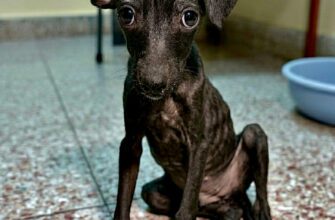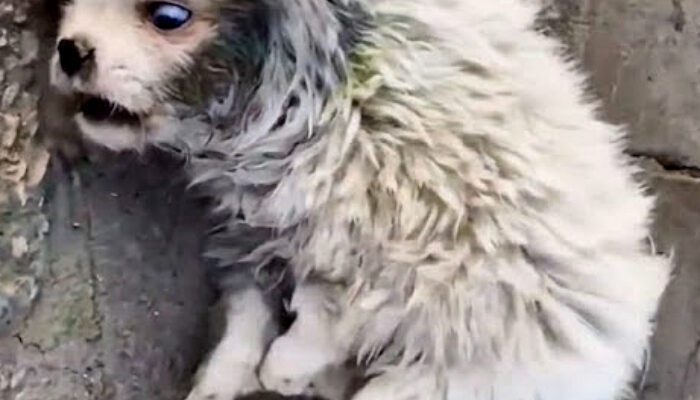
On the street, a tiny puppy rolled helplessly on the ground.
His body kept twitching. He screamed in p.a ìn.
People passed by — no one stopped.
By the time the rescuers arrived, he had already rolled to the side of the road.
Children nearby said he had been kicked by a sanitation worker.
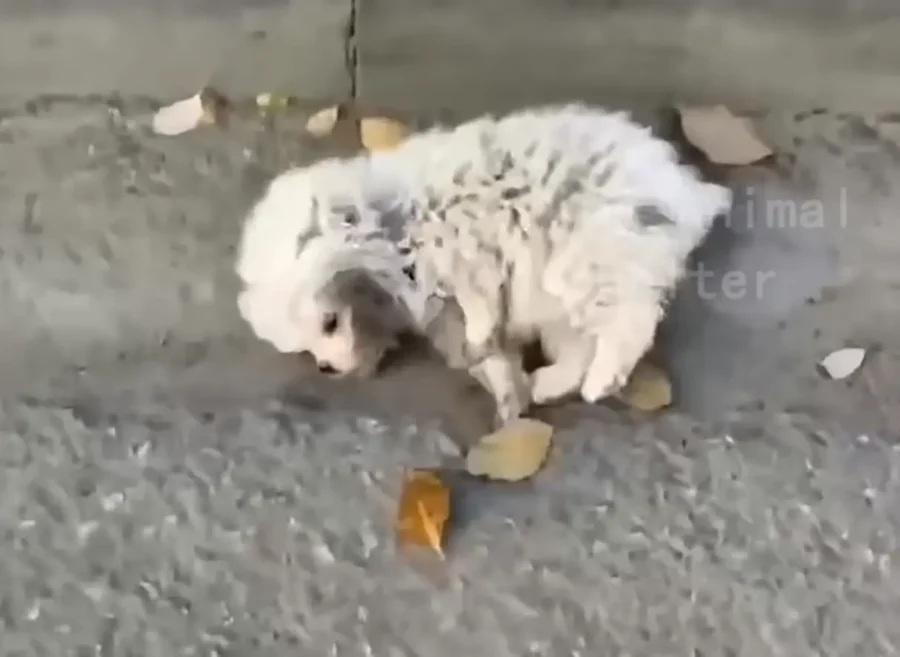
At that point, he had already been in.j ∪red for two long days.
For two days, the poor puppy cried for help.
Thanks to the children’s information,
the rescuers arrived just in time — before it was too late.
After being taken away, the puppy continued screaming in p.a ìn.
Painkillers and sedatives were injected, and slowly, he calmed down.
On the way to the hospital, he fell asleep like a baby.
At the hospital, X-rays and biochemical tests were performed.
The doctor said the puppy was less than three months old.
Severe t.r αuma had caused hydrocephalus, compressing his nerves.
High-concentration glucose was injected to reduce intracranial pressure.
The puppy also had congenital deformities of the forelimbs and congenital skull dysplasia.
This meant he would s.u ƒfer intermittent neuralgia.
He would need long-term care and companionship.
He was so small — only two tiny teeth.
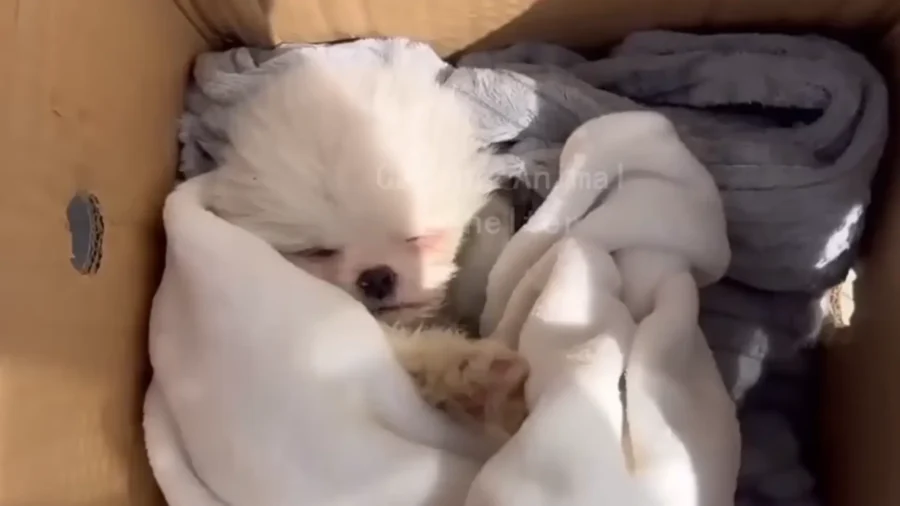
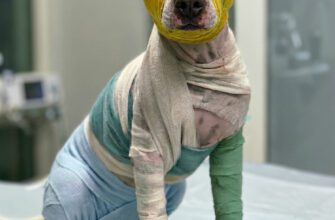
A few days later, the puppy underwent surgery.
When he woke from anesthesia, he screamed in p.a ìn.
The neuralgia came in waves, intense and unbearable.
The doctor said there would be at least ten days of critical d.a חger.
Watching him s.u ƒfer like that was heartb.r ℮aking.
All we could do was hope that careful, constant care would help him survive.
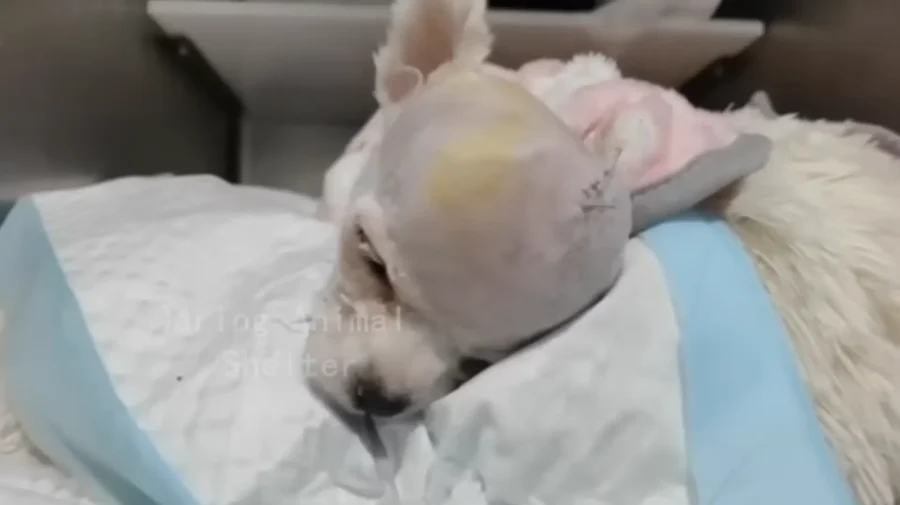
The cage was closed to let him rest.
He was fed once. Eventually, he fell asleep.
His eyes were extremely swollen, his pupils almost invisible.
He could eat a little liquid food — a small but hopeful sign.
On the second night after surgery, he screamed again from p.a ìn.
But slowly,
his condition began to improve.
We hoped this meant a good beginning.
On the third day, the puppy was named Qizai.
Qizai is the elf from the movie — and we hoped he could recover
with the same strength and magic.
After dinner, he drank water comfortably.
His eyes were still swollen, but much better than before.
Qizai was under 24-hour care in the hospital and remained in intensive care.
Visits were not allowed.
When awake, he was very well-behaved.
Sometimes he made nervous humming sounds.
The doctor said he wanted to go out and move, but he was far too weak.
At this age,he was like a five-year-old human child —
active, curious — yet forced to lie still in bed.
Later, his intraocular pressure dropped. He could finally open his eyes.
Laser treatment was applied to his head to help his brain recover.
His weight increased from 650 grams to 800 grams.
When neuralgia struck, he groaned softly.
He longed for someone to touch him, to ease the p.a ìn.
With gentle strokes, his p.a ìn seemed to lessen.
He relaxed. Closed his eyes.
Laser therapy continued every day.
Qizai showed a strong will to live and cooperated with every treatment.
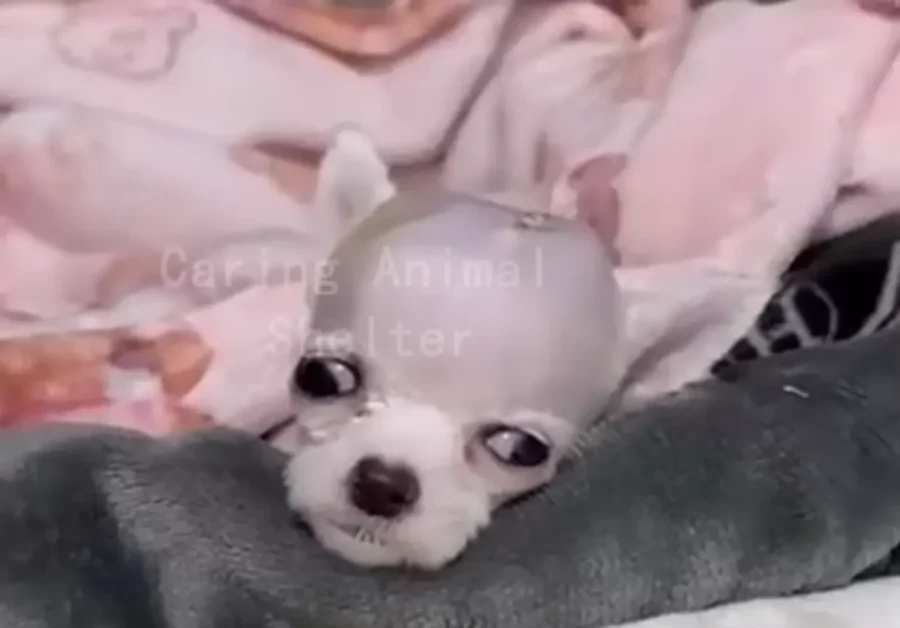
Later, the stitches were removed. He passed the most critical period.
Doctors said that, in the most optimistic case, he might walk again after six months.
Hyperbaric oxygen therapy was used to increase brain oxygen supply.
Day by day, Qizai improved visibly.
He ate eagerly. He grew stronger.
In the hospital, Qizai was a child surrounded by care.
He still made unconscious sounds, but the doctor said
he was no longer in p.a ìn.
This was a neurological aftereffect, similar to sequelae seen after canine distemper.
Volunteers came to visit him.
Qizai tried hard to lift his head and respond to their voices.
He even managed to hold a toy.
Everyone was relieved to see his improvement.
Qizai no longer needed liquid food. He could eat wet food.
If he didn’t like something, he simply refused to open his mouth.
He had become picky — only soft, tasty food would do.
He felt loved and enjoyed his little privileges.
Every day brought new changes.
But standing up was still a distant goal.
His in.j ∪ries were severe, and his front legs remained disabled.
After acupuncture treatment, he tried hard to stand.
Even that effort gave hope to everyone.
Qizai later underwent a second minor surgery, using steel to stabilize his skull and speed up healing.
He recovered well.
He began trying to eat on his own — a huge step forward.
The hospital tried many rehabilitation methods, including gently lifting his chin during feeding
to train forelimb support.
Qizai stayed in the hospital for two months.
He became more aware, more understanding.
When the rescuer visited, his eyes filled with tears.
He understood everything.
He curled into my arms like a baby.
So small. So precious.
Everyone believed he would slowly recover.
But fate was c.r ∪el.
During a visit, someone accidentally caused Qizai to fall.
He s.u ƒfered another head in.j ∪ry — worse than the first.
The fur that had finally grown back had to be shaved again.
Qizai became weak and listless.
His appetite faded.
But even if you can’t walk, Mom can carry you every day.
Push you in a stroller, watch the sunrise and sunset together.
Just being alive is enough.
Just get through today. Everything will be okay.
Qizai, I was always with you.
Please… just survive.
But Qizai l.e ƒt us.
Before dawn, the little one sl.i ρped away.
Qizai, you can finally go home now.
Mom will take you home.
You endured too much p.a ìn in such a short life.
It breaks our hearts that you never fully felt the warmth of a family.
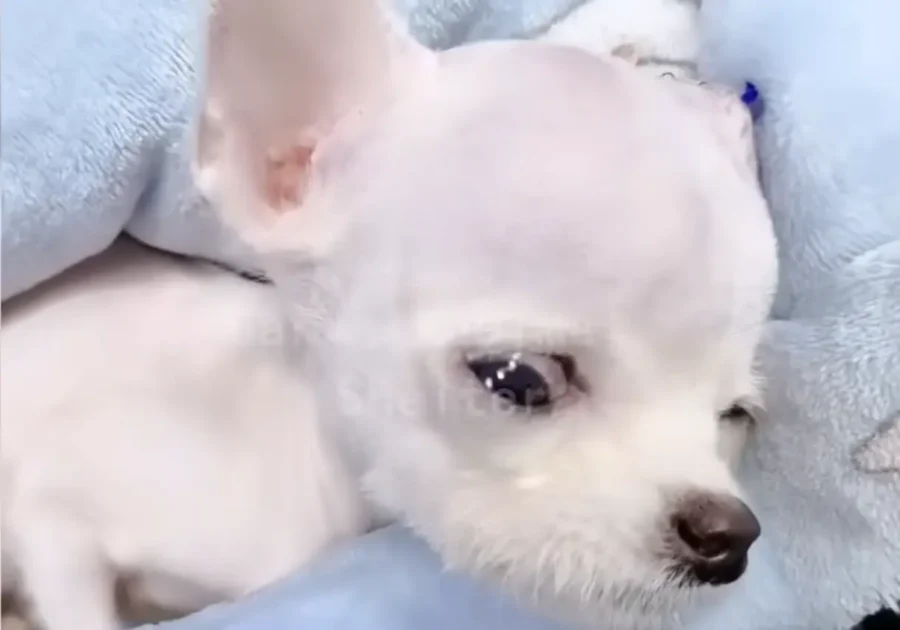
May there be no p.a ìn, no s.u ƒfering, where you are now.
➕