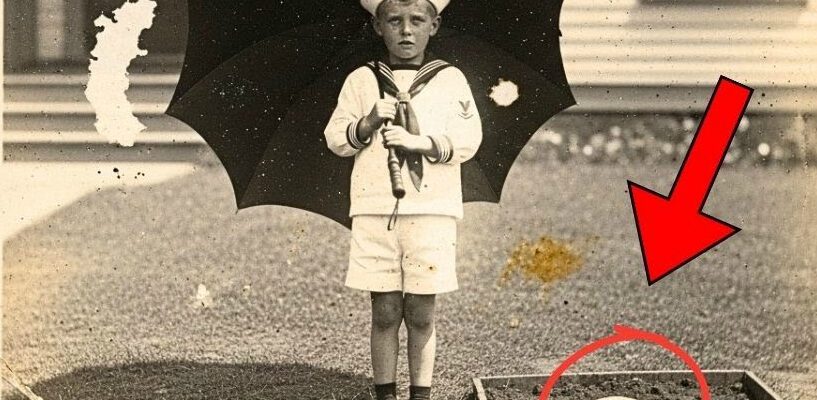
You’re looking at a photograph from August 1910 showing a young boy, approximately seven years old, standing alone in what appears to be the front yard of a Victorian house; he is dressed in a formal sailor suit and holds a large black umbrella despite the photograph clearly being taken on a bright, sunny day, and at first glance it looks like a charming Edwardian portrait of a well-dressed child posing seriously for the camera, the way children did in that era, but when a historical photograph restorer digitally enhanced the image in 2024, zooming in on details obscured by 114 years of damage and fading, she discovered something that made her immediately contact the F ᗸ I, because this was not just a portrait of a little boy with an umbrella but the last photograph ever taken of a child who vanished three hours later and was never seen again; in March 2024 photograph conservator Dr. Linda Chen received an unusual package at her studio in Portland, Oregon, containing a severely damaged photograph found during the demolition of an abandoned house at 412 Wickham Street in Salem, Massachusetts, where a hidden compartment behind a false wall in the basement revealed a single framed photograph deliberately concealed, showing the same boy identified by an inscription reading “Benjamin Ward, August 14th, 1910.
Gone by sunset. God help us all,” and historical records confirmed the Ward family lived there from 1905 to 1911 and that Benjamin Ward, age seven, vanished that same afternoon between 2:15 p.m. and 5:00 p.m. while playing in the yard, with no witnesses, no screams, and no trace, after which his parents abandoned the house and left Salem forever; Dr. Chen spent three months restoring the image using high-resolution scanning and AI-assisted enhancement, and what she uncovered was ch.i łling: Benjamin’s face showed not a neutral expression but absolute t.e ŕror, with dilated pupils, widened eyes, trembling lips, and a pleading gaze focused slightly off camera, which fo.r ℮nsic experts confirmed as clear markers of acute fear, and reflections in his pupils revealed two adults behind the camera—a man and a woman, likely his parents—standing on either side of the front door, blocking his way inside;
further analysis showed the umbrella he clutched was adult-sized, gripped with white-knuckled force like a shield, stained with caustic chemicals consistent with cleaning agents, wrapped with rope, and that Benjamin’s wrists bore fresh li.g αture marks, while the ground beneath his feet showed a freshly refilled rectangular pit consistent with a g.r αve, with a partially ex.p σsed white object identified by forensic anthropologists as likely human bone, which Benjamin appeared to deliberately indicate with the tip of his umbrella;
investigators later discovered the Wards had an older daughter, Margaret, who supposedly d.i ℮d of influenza a month earlier, yet no b.u ŕial record existed, and excavation of the yard uncovered the re.m αins of an 11-year-old girl k.i łl ℮d by blunt force t.r αuma and b.u ŕied there, proving Margaret had been mu.r đered; a hidden letter written by Alice Ward the day before Benjamin disappeared revealed intent, stating they must “deal with Benjamin as we dealt with Margaret” because he had seen everything, and sometime after the photograph was taken that afternoon, Benjamin Ward was mu.r đered by his parents and b.u ŕied elsewhere, his re.m αins never found, leaving the photograph as a 114-year-old c.r ìme scene hidden in plain sight, a child’s final desperate attempt to show the truth—what they did to his sister, and what they were about to do to him.
➕