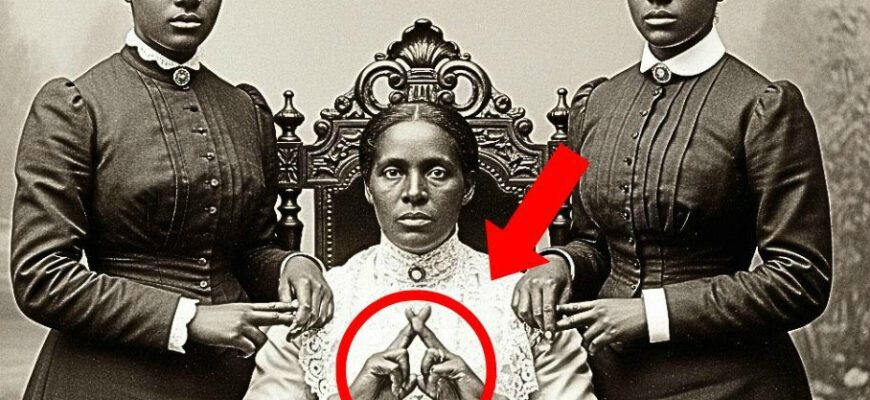
It was just a portrait of a mother and her daughters, but look more closely at their hands: Dr. James Mitchell had spent 15 years studying photographic archives at the New York Historical Society, yet he had never seen anything quite like this portrait, which arrived in a donation box from an estate sale in Brooklyn containing dozens of glass plate negatives wrapped in yellowed newspaper from 1923, most showing typical late 19th-century scenes of stern merchants, wedding parties, and children in Sunday clothes, until one image stopped him cold—three African-American women stared back through time, a mother of about forty seated in an ornate wooden chair with her two daughters, likely in their late teens or early twenties, standing on either side, all dressed in their finest high-collared dresses with intricate lacework, hair styled with care against a painted studio garden backdrop common for the era, and what unsettled James was not their dignified expressions but their hands: the mother’s hands rested in her lap with fingers interlaced in an unusual, deliberate pattern, her right thumb crossed over her left with index and middle fingers extended while the others curled inward,
and each daughter placed one hand on her mother’s shoulders with fingers arranged in similarly intentional configurations, far too precise to be coincidental in an era when photographers demanded absolute stillness during long exposures; examining the negative more closely, James noticed tiny numbers etched into the glass—NY892247—which haunted him enough to continue researching late into the night in his Upper West Side apartment, where high-resolution scans revealed extraordinary detail for 1892, from fabric textures to subtle facial differences, yet again it was the hands that drew his focus, their positions unmistakably conscious gestures requiring effort to maintain, reminding him of coded poses used by activists and underground networks, prompting him to consult Dr. Sarah Chen, a specialist in African-American history, who explained that after Reconstruction collapsed in 1877,
Black families in the North faced systematic exclusion through property disputes, inheritance denial, and identity verification barriers, leading communities to form mutual aid networks that created parallel systems of documentation hidden in plain sight; further investigation traced the photograph to Studio 247 on 8th Avenue, run by Thomas Wright, a white photographer known for welcoming African-American clients at equal rates and quietly believing photography was a tool for dignity and proof of existence, and with the help of cryptography historian Dr. Marcus Thompson, James and Sarah determined the hand positions formed a visual verification system encoding status, identity, and trust within these networks; court records revealed a lawyer, Robert Hayes, who repeatedly used such portraits to help Black families secure property rights, marriages, and legal recognition,
supported by church records that secretly cross-referenced Wright’s numbering system, and the women in the portrait were finally identified as Elellanar Morrison and her daughters Ruth and Grace, descendants of ens.l αved people who became central figures in this hidden documentation network; the discovery led to a major exhibition revealing how hundreds of African-American families protected their rights through coded photographs between 1888 and 1897, and in Elellanar’s diary James found the final confirmation: “Had our portrait made today. Mr. Wright understands what we are building. This picture will matter,” proving that what once seemed like a simple family portrait was in fact a quiet a.c ŧ of resis.t αnce, preservation, and survival—hidden for more than a century in plain sight, waiting for someone to look closely enough to see it.
➕